
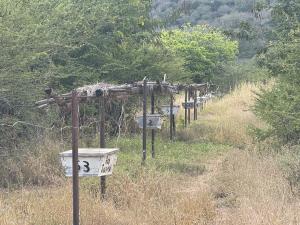
Africa’s proclaimed longest bee hive fence, built with Butterfly Pavilion and local partners to reduce human–elephant conflict through the natural defensive behavior of honey bees.
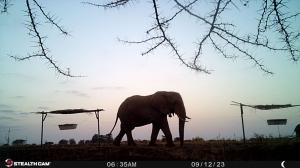
Stealthcam image of an elephant nearing a bee fence in Africa, a proven conservation tool that uses honey bees to safely deter elephants from farmland.
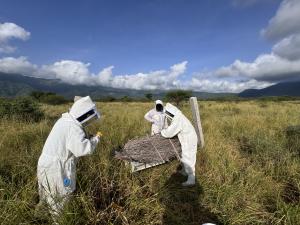
Butterfly Pavilion and local communities and partners construct Africa’s proclaimed longest bee hive fence, a nature-based conservation solution that uses honey bees to deter elephants and protect farmland.
Butterfly Pavilion announces completion of Africa’s proclaimed longest bee fence, showing how invertebrates support conservation solutions & advance innovation.
— Dr. Rich Reading, Vice President of Science and Conservation
WESTMINSTER, CO, UNITED STATES, November 28, 2025 /EINPresswire.com/ — Project highlights how invertebrates both solve environmental challenges and produce natural innovations with global impact.
Butterfly Pavilion, the world’s first Association of Zoos and Aquariums (AZA)-accredited standalone, nonprofit invertebrate zoo and global leader in invertebrate conservation, today announced the completion of Africa’s largest bee fence in the village of Kisiwani, Tanzania. The six-kilometer, community-led barrier uses honey bees to safely deter elephants from entering farmland, reducing conflict and supporting sustainable livelihoods for families living near wildlife.
“Invertebrates have solved engineering and ecological challenges long before humans existed,” said Dr. Rich Reading, Vice President of Science and Conservation at Butterfly Pavilion. “This project is a powerful reminder that solutions to some of the world’s biggest conservation problems often come directly from nature. Honey bees protect families and crops, support pollinator health, and keep wildlife corridors open, all in one integrated system.”
A Critical Need in Tanzania
Research and field trials show that bee fences can reduce crop raiding by up to 90 percent. At the same time, they boost pollinator activity, strengthen honey bee populations, and generate income through honey and wax sales. In many regions, these thriving apiaries also become a focal point for community-based ecotourism, attracting visitors interested in conservation, traditional beekeeping, and wildlife-friendly farming. Over time, communities learn to manage their hives independently, creating long-term sustainability beyond the initial installation period.
The fence surrounds the entire community of Kisiwani along the boundary of Mkomazi National Park. Tanzania does not fence its national parks, which allows wildlife to roam freely but creates significant risks for families farming near migration pathways. Elephants can destroy crops in a single night, endangering food security and human safety.
Butterfly Pavilion and its partners have worked with five villages in the region to build bee fences, install 1,090 hives, produce 1,036 kilograms of honey, and train more than 120 people in hive management, honey processing, and community-based conservation. Several villages now operate their fences and honey production independently.
“This fence has changed daily life for families in Kisiwani,” said Francisco Garcia Bulle Bueno, Ph.D. Butterfly Pavilion’s Director of Research and Conservation.
“Communities feel safer, crops are protected, honey production creates new income, and elephants can move through their natural landscape without confrontation. It is a conservation model that truly benefits everyone involved.”
How Bee Fences Work and Why Elephants Fear Honey Bees
Elephants have a well-documented, instinctive fear of honey bees. Despite their size, elephants have several extremely sensitive areas that bees can easily sting, including their eyes, their trunks, and the delicate skin inside their ears. Even a few stings can be painful and distressing, particularly for calves, which makes adult elephants especially alert to the sound and behavior of bees. This natural vulnerability drives elephants to avoid aggressive buzzing at all costs.
Bee fences use this natural behavior to protect farmland in a safe, non-lethal, and highly effective way. The fences consist of honey bee hives strung along a suspended wire around the perimeter of fields. When an elephant approaches and brushes the wire, the connected hives sway and activate the bees, whose defensive buzzing warns elephants to retreat to avoid painful stings to their eyes, trunks, and ears. In almost all cases, elephants turn away before any conflict escalates. This simple, nature-based technique helps prevent crop loss, reduces stress for farming families, and keeps wildlife corridors open.
A Broader Story of Invertebrate Innovation
The success of the bee fence reflects a much larger story about the importance of invertebrates as natural problem solvers. For millions of years, invertebrates have engineered the structures and systems that humans depend on today.
• Honey bee hives display extraordinary structural efficiency through the perfect hexagonal symmetry of their individual hive cells.
• Coral reefs built by coral polyps act as natural breakwaters that protect coastlines from storms
• Spiders produce silk stronger than steel by weight, influencing parachute materials and advanced fibers
• Termite mounds regulate temperature through natural ventilation, inspiring energy-efficient building design
• Soil invertebrates enrich farmland, build soil structure, and support nutrient cycling
• Invertebrates break down organic material, recycle nutrients, manage pests, and support entire ecosystems
These examples show how invertebrates shape the natural world in ways that directly benefit communities, wildlife, and long-term environmental health. The Bees for Elephants project puts this knowledge into action by using a natural behavior to prevent conflict while strengthening community resilience.
Project Impact
• Six kilometer bee fence completed in Kisiwani, Tanzania
• 1,090 honey bee hives installed across participating communities
• 1,036 kilograms of honey produced, generating new sustainable income
• More than 120 people trained in beekeeping, hive management, honey processing, and entrepreneurship
• Secure honey processing facility established with 20 thousand kilogram annual capacity
• Swahili-language training materials developed for community use and long-term knowledge sharing
• Two villages now independently operating fences and honey production
• Project expansion underway in Botswana to replicate the successful model
The initiative is implemented in collaboration with the Tanzanian Elephant Foundation (TEF), the Katie Adamson Conservation Fund, and local leaders who maintain and steward the fence systems.
Building Toward a Global Model
Butterfly Pavilion plans to continue expanding the program, supporting new villages in Tanzania while advancing research on how bee fences strengthen pollinator health, enhance crop yields, and support climate resilience. The success of the Kisiwani fence provides a roadmap for other regions grappling with human wildlife conflict and offers an inspiring example of conservation driven by communities
Butterfly Pavilion, celebrating its 30th year in 2025, has been part of the Colorado community since 1995 and is the first Association of Zoos and Aquariums (AZA)-accredited, stand-alone, non-profit invertebrate zoo in the world, located in Westminster, Colorado. Beyond Colorado and the United States, Butterfly Pavilion conservationists are doing important invertebrate research, conservation and education projects around the world. www.butterflies.org
Jennifer Quermann
Butterfly Pavilion
+1 7034770668
email us here
Visit us on social media:
LinkedIn
Facebook
YouTube
TikTok
Legal Disclaimer:
EIN Presswire provides this news content “as is” without warranty of any kind. We do not accept any responsibility or liability
for the accuracy, content, images, videos, licenses, completeness, legality, or reliability of the information contained in this
article. If you have any complaints or copyright issues related to this article, kindly contact the author above.

Article originally published on www.einpresswire.com as Butterfly Pavilion Announces Completion of Africa’s Proclaimed Longest Bee Fence to Tackle Major Conservation Challenges