
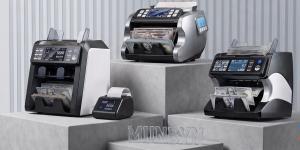
MUNBYN highlights the growing role of automated cash counting as businesses balance digital payments with continued demand for cash handling
LOS ANGELES, CA, UNITED STATES, September 21, 2026 /EINPresswire.com/ — The continued growth of digital payments has changed how consumers pay, but recent Federal Reserve research indicates that cash remains a consistent part of the U.S. payment landscape. Against this backdrop, businesses that continue to accept physical currency are reassessing how cash is counted, verified, reconciled, and prepared for deposit.
The 2026 Diary of Consumer Payment Choice from Federal Reserve Financial Services found that U.S. consumers made an average of 47 payments per month in 2025. Six of those payments were made with cash, representing approximately 14% of total payments. The study also found that four out of five consumers had used cash during the previous 30 days, while 90% said they planned to continue using cash in the future.
MUNBYN, a provider of business hardware including thermal printers, barcode scanners, and cash-handling equipment, is examining what these payment trends mean for businesses that continue to manage physical currency alongside digital transactions.
Cash Remains Part of a Multi-Channel Payment Environment
The latest Federal Reserve findings suggest that the shift toward digital payments has not eliminated cash from everyday commerce. Cash remained the third-most-used payment instrument in the 2026 survey, while credit and debit cards together accounted for approximately two-thirds of consumer payments.
The role of cash also varies among different consumer groups. Federal Reserve data found that adults aged 55 and older and households with lower incomes tended to use cash more frequently than other groups. Rural consumers also reported more cash payments than consumers in urban and suburban areas. For businesses, the result is a payment environment in which cash and digital methods often operate side by side.
A retailer may accept credit cards, mobile wallets, and cash at the same checkout. Restaurants can receive digital orders while continuing to process cash transactions. Service businesses, local stores, entertainment venues, and temporary retail locations may also maintain cash-handling procedures even as digital payment options become more widely available. This creates an operational challenge that is separate from the payment technology used at checkout: physical currency still has to be counted and reconciled after a transaction has taken place.
Cash Counting Remains a Back-Office Task
Counting cash is often treated as a routine administrative task, but the process can become more involved as transaction volumes increase. At the end of a shift, employees may need to collect cash from registers, separate different denominations, count bills, compare the total with sales records, and prepare the day’s receipts for deposit. Businesses operating multiple registers or shifts may repeat this process several times throughout the day.
Manual counting can also introduce additional reconciliation steps when totals do not match sales records. Automated money counters address one part of this workflow by mechanically counting currency. Depending on the machine and its functions, some models can also identify denominations or provide detection features for potentially suspicious notes.
The technology does not replace a business’s accounting or cash-control procedures. Instead, it represents one of several tools that businesses can incorporate into their existing processes for handling physical currency.
Mixed Denomination Counting Changes the Workflow
One area receiving attention within the money counter category is mixed denomination counting. In a traditional workflow, employees may first separate bills into groups such as $1, $5, $10, $20, $50, and $100 denominations before counting each group. This approach can be practical for smaller amounts, but sorting becomes an additional step when businesses handle larger quantities of mixed bills.
A mixed denomination money counter can process different denominations together and, where supported, calculate their combined value. The specific capabilities vary by machine, so businesses need to consider which denominations and currencies a particular model supports before incorporating one into their workflow. For businesses that handle cash regularly, the distinction is less about replacing manual cash controls and more about reducing the number of repetitive counting and sorting steps performed by employees.
Accuracy and Verification Remain Important
Cash counting is only one part of the reconciliation process. Businesses typically need to establish procedures for recording cash received, comparing register totals with sales data, verifying deposits, and investigating discrepancies. Automated equipment can assist with counting, but it does not eliminate the need for appropriate internal controls. When evaluating a money counter, businesses may therefore consider several factors beyond counting speed:
-Whether the machine supports mixed or sorted denominations
-Supported currencies and bill sizes
-Counting capacity and operating speed
-Available counterfeit or detection functions
-Display configuration
-Ease of use for different employees
-Noise and operating conditions
-Compatibility with existing cash-handling procedures
-Maintenance and service requirements
The appropriate combination depends on the type and volume of cash transactions a business handles. For a small retailer, ease of operation may be more relevant than maximum throughput. A business operating several registers may place greater emphasis on counting capacity and repeatability. Restaurants and other customer-facing businesses may also consider equipment size and operating noise.
Counterfeit Detection Is a Separate Consideration
Cash management also involves determining whether notes are genuine. Federal Reserve Banks state that counterfeit or unlawfully altered U.S. currency is not accepted for deposit. The Federal Reserve also advises that the best way to determine whether a note is genuine is to rely on the security features incorporated into genuine Federal Reserve notes.
This distinction is relevant when businesses evaluate cash-counting equipment. A machine that counts bills is not necessarily equivalent to a dedicated authentication system, and detection technologies differ among models.
Businesses using automated equipment should therefore review the specific detection functions available on a machine and maintain procedures for examining notes that are flagged or otherwise considered questionable. The Federal Reserve’s deposit guidance also states that notes prepared for deposit should be piece counted and verified for authenticity.
Technology Is Changing the Cash-Handling Workflow
The evolution of cash management reflects a broader change in how businesses use technology. A modern small business may already rely on multiple hardware systems, including point-of-sale equipment, barcode scanners, thermal label printers, inventory software, and shipping platforms. Cash handling represents another operational process that can be incorporated into this broader technology environment.
For businesses that receive both physical and digital payments, the objective is not necessarily to favor one payment method over another. Instead, businesses need processes that allow different payment types to be recorded and reconciled consistently. This is particularly relevant for businesses operating across multiple sales channels. An e-commerce company with a physical storefront, a restaurant with both online and in-person orders, or a retailer with multiple locations may encounter different cash-handling requirements within the same organization.
What Businesses Can Consider When Reviewing Cash-Handling Processes
The continued use of cash provides businesses with an opportunity to review how physical currency moves through their operations. A basic review can begin with several questions: How frequently is cash counted? Who is responsible for the count? Are bills sorted before counting? How are discrepancies documented? How is cash prepared for deposit? And does the existing process remain practical as transaction volumes change?
For businesses with relatively low cash volume, manual counting may remain appropriate. For organizations that handle larger quantities of bills or repeat the same process across multiple shifts, automated counting equipment may be worth evaluating as part of a broader workflow.
The key consideration is not simply the number of bills a machine can count per minute. Businesses also need to consider how the equipment fits into existing reconciliation, verification, recordkeeping, and deposit procedures.
MUNBYN Observes Continued Demand for Cash-Handling Equipment
The Federal Reserve’s latest research provides a broader context for businesses evaluating these processes. Despite substantial changes in payment technology, consumer payment behavior has remained relatively stable over the past several years, with cash continuing to account for a measurable share of transactions.
MUNBYN’s business hardware portfolio includes equipment for retail, e-commerce, shipping, inventory, and cash-handling workflows. Its money counter range includes models such as the IMC22, which supports mixed denomination counting.
The company is positioning its money counter products within the wider context of business cash management rather than as a replacement for point-of-sale or accounting systems. The role of such equipment depends on each organization’s transaction volume, internal controls, and cash-handling procedures.
As payment options continue to diversify, businesses may increasingly operate hybrid payment environments in which cash remains one component of a broader transaction system. For those businesses, counting, verifying, reconciling, and preparing physical currency for deposit will continue to be practical operational tasks. The latest Federal Reserve data suggests that the question for businesses is therefore not simply whether consumers are moving toward digital payments, but how physical cash fits alongside those payment methods in everyday operations.
About MUNBYN
MUNBYN provides business hardware and technology products for retail, e-commerce, shipping, inventory, and related business workflows. Its product portfolio includes thermal label printers, shipping labels, barcode scanners, money counters, and other business equipment. For more information, visit MUNBYN.
Nada
MUNBYN
email us here
Legal Disclaimer:
EIN Presswire provides this news content “as is” without warranty of any kind. We do not accept any responsibility or liability
for the accuracy, content, images, videos, licenses, completeness, legality, or reliability of the information contained in this
article. If you have any complaints or copyright issues related to this article, kindly contact the author above.

Article originally published on www.einpresswire.com as Money Counters Gain Importance as Businesses Continue to Handle Cash
