
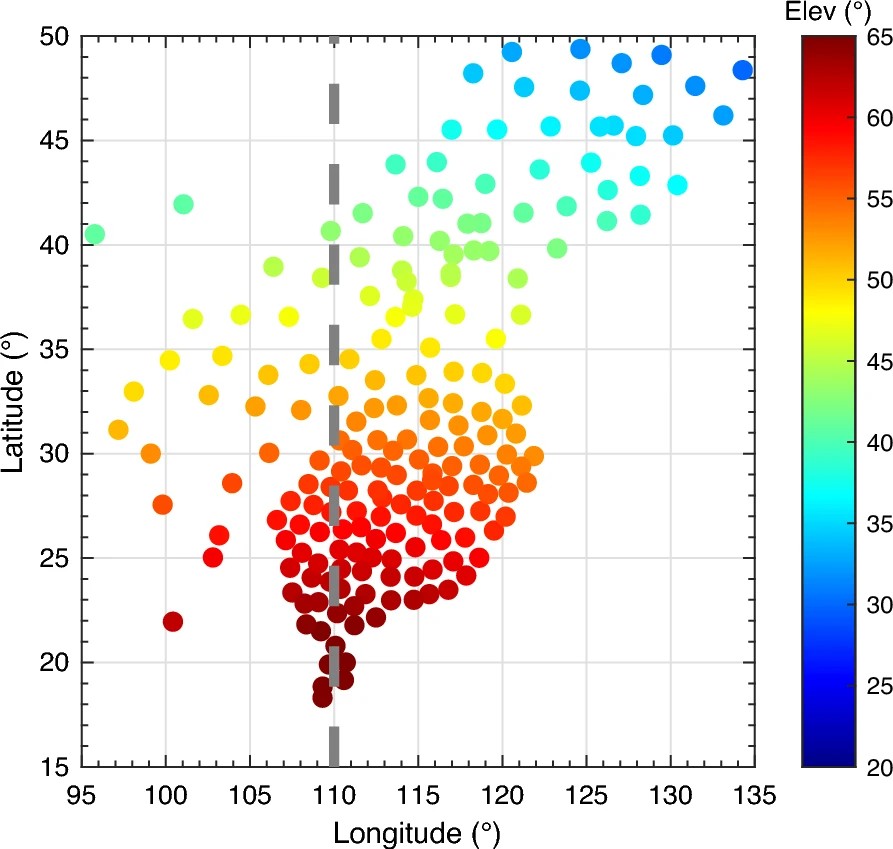
The location of the receivers. The pseudo-color indicates the mean elevation angle of the LOS from the GEO satellite C03 to each receiver on 2024-09-21. The gray line marks the mean sub-satellite longitude of C03.
GA, UNITED STATES, December 19, 2025 /EINPresswire.com/ — Accurate, real-time monitoring of ionospheric dynamics is essential for understanding space weather and protecting satellite-based navigation and communication systems. A new study introduces an innovative observation framework that captures rapid and fine-scale ionospheric variations by directly measuring spatial and temporal gradients of total electron content. By exploiting a stable geometric configuration between geostationary satellites and ground-based receivers, the approach achieves high spatial resolution and continuous temporal coverage without relying on interpolation or satellite motion corrections. This enables the detection of ionospheric structures across multiple scales, from gradual daily evolution to fast-developing disturbances, offering a more precise and dynamic view of ionospheric behavior than existing monitoring techniques.
The ionosphere is a highly dynamic region shaped by solar radiation, geomagnetic activity, and atmospheric processes, and its variability can severely disrupt satellite navigation and communication signals. Traditional monitoring methods face inherent trade-offs: low-Earth and medium-Earth orbit satellites provide limited temporal continuity, while ground-based instruments offer only regional coverage. Global ionospheric maps, though comprehensive, often smooth out short-lived or fine-scale disturbances. As a result, critical processes such as equatorial ionization anomalies, plasma instabilities, and traveling ionospheric disturbances are difficult to observe in real time and with sufficient resolution. Based on these challenges, there is a pressing need to develop advanced monitoring frameworks capable of resolving ionospheric dynamics across both space and time.
Researchers from Sun Yat-sen University and the Chinese Academy of Sciences, together with international collaborators, report a new ionospheric monitoring framework in a study published (DOI: 10.1186/s43020-025-00187-4) in Satellite Navigation in 2025. The team developed a fixed-geometry observation network using geostationary Earth orbit satellites and dense ground-based GNSS receiver arrays. By focusing on ionospheric gradient measurements rather than traditional point observations, the study demonstrates a new way to observe ionospheric evolution with unprecedented spatiotemporal resolution and consistency.
The new framework leverages the stationary geometry between geostationary satellites and ground receivers to form dense, fixed ionospheric pierce points connected by geometry-invariant baselines. Each baseline acts as an independent sensing unit, allowing researchers to directly estimate spatial and temporal gradients of total electron content at a resolution finer than 0.25° and a time step of 30 seconds. Unlike conventional methods, this approach avoids errors introduced by satellite motion and interpolation smoothing.
Using several case studies, the researchers demonstrated the framework’s capability to capture complex ionospheric phenomena. During the daily evolution of the equatorial ionization anomaly, the method resolved sharp gradient structures and tracked crest migration in near real time. For equatorial plasma bubbles, the system identified steep density gradients and nonlinear plasma instabilities, revealing their growth, drift, and dissipation with high precision. The framework also successfully characterized large-scale traveling ionospheric disturbances during geomagnetic storms, capturing their propagation speed, wavelength, and interaction with background ionospheric structures. Together, these results show that gradient-based monitoring can reveal both linear and nonlinear ionospheric processes that are often obscured in traditional observations.
“This framework fundamentally changes how we observe the ionosphere,” said one of the study’s authors. “By focusing on geometry-consistent gradient measurements, we can directly track how plasma structures evolve in space and time, rather than inferring them from sparse snapshots. This allows us to distinguish between gradual transport processes and rapidly developing instabilities, offering a much clearer physical interpretation of ionospheric behavior, especially during disturbed space weather conditions.”
The proposed approach provides a scalable and cost-effective foundation for continental-scale ionospheric monitoring and real-time space weather diagnostics. Its high resolution and continuity make it particularly valuable for early warning of ionospheric disturbances that degrade GNSS positioning accuracy and communication reliability. Beyond operational applications, the framework opens new possibilities for studying ionospheric coupling processes, validating ionospheric models, and improving mapping functions used in navigation systems. As global GNSS and geostationary satellite infrastructures continue to expand, this method could play a key role in building long-term, high-resolution ionospheric datasets to support both scientific research and practical space weather services.
DOI
10.1186/s43020-025-00187-4
Original Source URL
https://doi.org/10.1186/s43020-025-00187-4
Funding Information
This work was supported by the National Natural Science Foundation of China (42374181, 42374186, 42441814), Key Innovation Team of China Meteorological Administration ‘Space Weather Monitoring and Alerting’ (CMA2024ZD01), ‘Ionospheric Forecast and Alerting’ Youth Innovation Team (CMA2024QN09), Shandong Key R&D Program (2024CXGC00116) and Jinan Haiyou Leading Talents Of Industry.
Lucy Wang
BioDesign Research
email us here
Legal Disclaimer:
EIN Presswire provides this news content “as is” without warranty of any kind. We do not accept any responsibility or liability
for the accuracy, content, images, videos, licenses, completeness, legality, or reliability of the information contained in this
article. If you have any complaints or copyright issues related to this article, kindly contact the author above.

Originally published at https://www.einpresswire.com/article/876798760/seeing-the-ionosphere-in-motion-a-new-way-to-track-space-weather-in-real-time